
Door Diary: Drinking with Mr D’Arcy
We had a drink recently at the historic Ram Inn in Wandsworth. We found it in our book Doors of London, which we’re using to choose our days out. We were so taken with it that we’ve written a Door Diary about it and its link to a grandly named sheep.
Though not a typical first choice at a pet shop, a ram can be a memorable mascot. The Young family who bought the Ram Inn in 1831 used the pub’s accompanying stables to house their pet ram, RamRod D’Arcy. Mr D’Arcy was far from the only resident (being part of a diverse flat share with chickens, geese, ducks, peacocks, cats and the shire horses that transported the beer) but he was a uniquely important animal. If ever you have walked into a Young’s pub and sat down to order through their app, there you will see RamRod the ram proudly depicted on the Young’s logo.
A Memory of What Was
Although no longer owned by the company, the Ram Inn is still closely associated with Mr D’Arcy. On columns of pale terracotta tiles, moulded Young & Co’s signs can be found. Mr D’Arcy stands at the top, in front of rolling green hills under gold-tinted clouds with a peek of blue sky. The pub was one of 82 initially purchased by Charles Allen Young and Anthony Fothergill Bainbridge in 1831, along with the accompanying Ram Brewery.
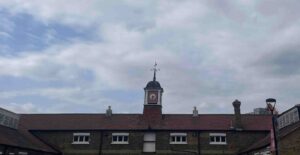
The outbuildings, stables and pub are all that still stand. The brewery and the rest of the surrounding architecture has been demolished to make way for a modern development called The Ram Quarter. With all three being Grade II listed, their historic appearance will persist for years to come, grounding any new developments in the site’s history.
A Day Out with Sheldrake’s Interns
The breadth of history associated with the Ram Inn is part of what made it so appealing for a day out. Turning to the end of the Lambeth & Wandsworth chapter in Doors of London, we found that the pub had been rebuilt after a fire in 1883, remodelled in the 1930s and damaged by bombing in the Second World War, yet still served drinks for a full 170 years until it closed in 2006. It reopened in 2019.
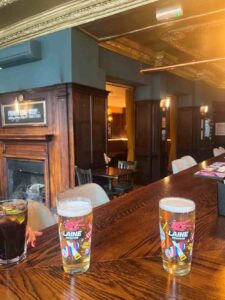
As we had new staff members joining and others departing, this visit served two purposes. One was exploring the doors that were time-consumingly gathered in our book, and the other was contributing to these doors with stories of our own. From memories made with new colleagues before we stepped through the pictured timber double doors, to conversations on trains, nearly losing our way whilst trying to find a bus stop, we metaphorically filled our notebooks for our first Door Diary. Upon entering, though not short of seat choices thanks to it being a weekday afternoon, we chose to drink in the garden, a small square surrounded by brick walls, made comfier by the vines and leaves climbing up.
Thanks to directions from the barman, we were able to find the stables, though our view was restricted by boards covering up construction work. The boards did however advertise that the building was being converted into a dining area, enabling future visitors to drink and dine where Mr D’Arcy once dwelled.
From Companion to Company Logo
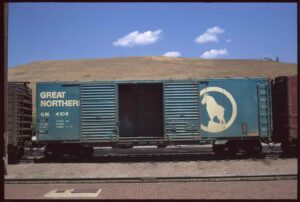
As editors we are no strangers to eponymous wildlife in corporate branding. Our book Logomotive, on the graphics of US railroads, included a spread about the mascot of the Great Northern Railway, a mountain goat stood atop a rocky crag. The logo was suggested in 1921 by their Vice President, William Kenney, who was inspired by the billy goat that hauled his newspaper cart when he was a boy. A both relevant and personal image, the logo stood the test of time, still being present on goods vans even after the company was absorbed by Burlington Northern in 1970.
Though not of the four-legged variety, the Sheldrake that serves as our logo and namesake was taken from our Publisher’s family crest, continuing a tradition of family animals turned graphic icons.