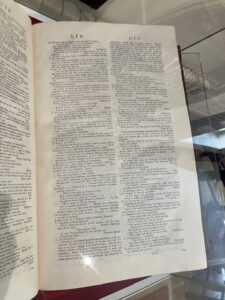
Lounge in a Literary Workshop
Walk up to the top floor at 17 Gough Square, London, EC4 and you find yourself in a literary workshop. Here, seated at a modest drop-leaf table, Samuel Johnson wrote A Dictionary of the English Language, with his six assistants toiling at adjoining desks. Sit yourself down and you’re soon back with them in 1750.
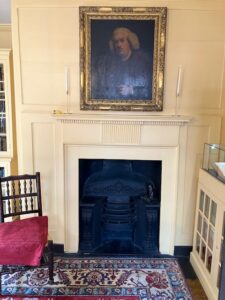
The great thing about Dr Johnson’s house is that you can make yourself at home. The day I visited, my phone rang and I was about to say I couldn’t stop to speak when I spotted a rush-seat chair in a quiet corner, so I sat down and took the call. Later, I found a window seat where I could sit and lounge.
In the library, there are books on the open shelves that you can take out and sit and read.
As an editor, the first thing I wanted to see was the so-called ‘garret’ at the top of the house where all the editorial work was done. Actually, it is a large, airy room with plenty of space for desks, reference books, paper, pens, ink pots and all the paraphernalia of an editorial office. Here Johnson and his team worked for nine years, researching, selecting and defining more than 40,000 words with examples of their use gleaned from ‘the Best Writers’, as Johnson put it. He quoted most frequently from Shakespeare, but also from Milton, Pope, Swift, Addison and Steele.
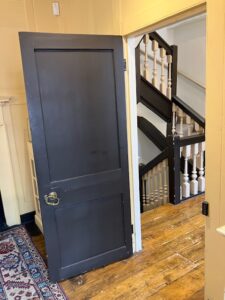
From the garret, I decided to work my way down the house, floor by floor. I was in the guest bedroom on the second floor when a voice called out, ‘Is anyone there?’ It turned out to be Liz, a volunteer at the house, saying she was about to give a talk and would I like to join her.
A Home for Wordsmiths
A small group of us sat down round a table on the first floor and Liz asked us why we were there. I said I’d published a book called Doors of London in which Dr Johnson’s house was mentioned, and I wanted to see it for myself. The lady to my right turned out to be an editor who had worked at other London publishers, and to her right was a barrister. Liz was a teacher and translator. All of us were, in one form or another, wordsmiths.
Seated comfortably in the house of one of England’s most famous wordsmiths, we were regaled with stories of how Johnson put the dictionary together, marking quotations in source books and handing them to his copyists who wrote out the chosen examples on large, folded sheets of paper. Johnson himself added the definition, showing his flair for word choice.
‘How would you define a thumb?’ Liz asked us.
After we had voiced our muddled thoughts, she told us Johnson’s:
‘The short strong finger answering to the other four.’
And how did he define lexicographer?
‘A writer of dictionaries; a harmless drudge…’
Dr Johnson never lost his wit, even in his darkest moments. And he had plenty of those. We heard how, when he first came to London and worked as a jobbing journalist, he was always short of money, frequently moving lodgings to escape his creditors.
Then, when a group of booksellers offered him 1,500 guineas to write the dictionary – more than £400,000 now – he suddenly could rent this fine house, employ staff and gratify his beneficent instincts by offering support and lodgings to those who were down on their luck, turning the building into a community as well as a workshop.
A Door to Deter Creditors
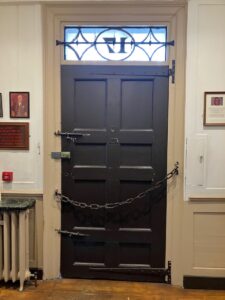
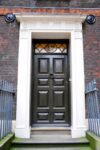
Even then, because the booksellers wisely paid him in instalments, Johnson frequently ran out of money and had bailiffs trying to break down the door. Which is where we get to the door in our book, Doors of London.
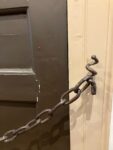
The door of 17 Gough Square is notable for its anti-burglar devices. It has a spiked iron bar behind the fanlight, strong bolts and a heavy chain across its waist secured with a corkscrew latch so that burglars or bailiffs, if they had broken through the fanlight, could not lower a hook and lift off the chain.
The money from the investing booksellers was reckoned to be enough for an editorial operation lasting three years, whereas the work took three times longer than that. And then, when the dictionary was finished and published in 1755, Johnson had no more money!
He remained in penury until his friends spoke up for him and George III awarded him a pension of £300 a year, enabling him to become the portly figure we know from his portraits.
Having had to leave Pembroke College, Oxford, after just one year because of debt, Johnson spent most of his life without the moniker Dr before his name. As an undergraduate, he earned a reputation for being a ‘lounger’, as his friend Bishop Percy described him, ‘lounging at the College gate, with a circle of young students around him, whom he was entertaining with his wit and keeping from their studies’ in ways that did not suggest habits of industry or rigorous self-application.
No Lounger Dr Johnson
‘Ah, sir, I was mad and violent,’ he said of his time at Oxford. ‘I was miserably poor and I thought to fight my way by my literature and wit.’
When his reputation as a writer finally brought him money, he discovered application.
Belatedly, he was awarded an honorary doctorate by Trinity College, Dublin, in 1765 and another by his old college in 1775, so achieving deserved recognition for his exceptional flair with words and the industry with which he accomplished his life’s major task.
A Dictionary of the English Language: In Which the Words Are Deduced from Their Originals, and Illustrated in Their Different Significations by Examples from the Best Writers remained the standard English dictionary until the first edition of the Oxford English Dictionary came out in 1928. Unchallenged for more than 170 years – that’s no small achievement for a lounger.